Actor Research
As our target audience is male, we decided that our main protagonist should be male. As our target audience age is between 15 and 35, we decided to use an actor that was around this age group. We decided to use my Dad, as he is a very typical looking man, who is very active and is around the age range that we needed. He would also be readily available, as he would be on set constantly, and so we would not have to worry about transport or if he did not show up on time.




Character Profiles
In Films similar to ours, I found that there was a typical rule of the characters in the groups. These are:
In Survival films, there also tends to be separate groups, with there being conflicts when they come together, thus these other survivors being seen as "The Enemy".
In our film, we want to stick to these stereotypical roles, as we want to set the audience up in believing that they are going to see a typical survival film, but then we will have a twist, and so, due to the expectations they had, will shock them.
The protagonist of our film is the Lead, "Alpha" male. This is due to the fact that our target audience will be mainly males, and so we want to appeal to them, as the audience will want to relate to the lead character.
- The "Alpha male": This character typically takes charge of the group and is either the self-elected or voted leader of the Group.
- The "Opposing male": This character will be in constant competition with the Alpha male, wanting power over the group, and contesting The Alphas instructions/ decisions.
- The "Alpha female": This girl is usually the equal, but also opposite of the alpha male; wanting to help the group and take control, but will be oppressed by he rest of the group for being a female. This can lead to her becoming bitter/ being seen as a bit of a bitch.
- The "Hunter": This character tends to be very physically powerful, being the one who is the fighter/ hunter of the group, so tends to be very physically fit and strong. Although physically more powerful than the alpha male, the hunter does not lead the group, as He tends not to want the responsibility.
- The "Mother" of the group: This character is a female, who has the stereotypical traits of what a mother should be: caring, kind, thoughtful, and so takes care of the group as a whole, she differs from the alpha male, as cares more about how they are feeling, rather than that of their physical survival.
- The "New Generation": Some groups will contain children, who the rest of the group take it upon themselves to take care of.
- The "Weak Link": This character does not tend to conform with the rest of the group, often causing problems for the group and their survival.
- Hero: Reacts to the donor and saves the princess, often resulting in them falling in love with the princess.
- The villain: Is in a constant struggle with the hero, often trying to harm "princess".
- The donor: Gives the hero an objective or information that aids the Hero's quest.
- The helper: Assists the hero with their quest, often referred to as their 'sidekick'.
- The princess: Needs "saving" from the hero, usually because they are in some form of danger, typically the princess is the victim.
- The dispatcher: Is the character who sends the hero on their mission or quest.
- False hero: May appear good but has an ulterior motive, or attempts to take credit for the hero's actions. An example of this type of character is a double agent in a spy movie.
In Survival films, there also tends to be separate groups, with there being conflicts when they come together, thus these other survivors being seen as "The Enemy".
In our film, we want to stick to these stereotypical roles, as we want to set the audience up in believing that they are going to see a typical survival film, but then we will have a twist, and so, due to the expectations they had, will shock them.
The protagonist of our film is the Lead, "Alpha" male. This is due to the fact that our target audience will be mainly males, and so we want to appeal to them, as the audience will want to relate to the lead character.
Genre
We do not have specific genre, rather our film is a cross over of a few different genres. These are:
How we would represent this in our film:
As our film genre is a combination of all of the above, to keep it simple for the audience, we decided to stick to these conventions of the film very explicitly.
Example of these genres:
- Thriller
- Action
- Horror
- and Science Fiction
In order to be able to create a convincing opening, I have researched the conventions of these Genres.
- Thriller:
- Uses a lot of of suspense, tension and excitement in the films.
- Stimulates the audience's mood. Creates a heightened atmosphere within the film/ audience.
- Feelings that are created within the Audience include anticipation, uncertainty, surprise, anxiety and/or terror.
- Features that are included within thriller films include being high-adrenaline, fast-paced and often include devices such as a McGuffin, Plot twists and Cliff hangers.
- Tend to have a "Villain" of the story, who challenges the "hero" of the story, and presents challenges that the protagonist must figure out/ overcome.
- A thriller must keep the audience on the edge of their seat, and must keep their attention and keep them alert.
- In the plot of a thriller there are certain features that are very stereotypical, and tend to feature in almost all thrillers, these are: The Protagonist is faced with a problem, be it they are trapped and need to escape, they are set with a mission, or there is a mystery that they need to solve. There will also always be an accentuation on the danger that the protagonist is in, causing tension that leads to a very definitive climax.
- Action:
- Have a series of obstacles/challenges that the protagonist of the film must overcome in order to reach the equilibrium point of the film again(Todorov's theory)
- These challenges are often very physically straining and testing. E.g. fighting, chases etc.
- Tends to feature a character battling against the odds
- Normally end with the hero succeeding in victory.
- Horror
- Set out to create a negative emotional reaction in the audience
- Tends to play on the primal fears of the audience e.g. death, loneliness, beasts etc.
- Feature scenes that aim to startle, shock and scare the audience.
- Science Fiction:
- Based around the theme of science-based phenomena, but not the "mainstream" sciences.
- some of these include: ET lifeforms, time travel, perception and technologies.
- Often used to bring focus to political/social issues, or to explore philosophical issues.
How we would represent this in our film:
As our film genre is a combination of all of the above, to keep it simple for the audience, we decided to stick to these conventions of the film very explicitly.
- Thriller:
- We will build tension in the opening of our movie
- We will use a McGuffin (phones)
- We will keep the stereotypical characters of a thriller, e.g Hero, villain etc.
- Action:
- The protagonist will have to overcome a series of obstacles
- The lead character is batteling the odds, as most of the humans on Earth have been killed.
- Horror:
- Features the key theme of Death.
- Our scenes will evoke a negative reation/emotion from the audience.
- SciFi:
- Technology is a key theme in our film.
- Used to question social media, and its mass scale/power.
- Thriller:
- Psycho:
- Action:
- James Bond films (Skyfall)
- Horror:
- 28 days later
- Scifi:
- 12 Monkeys
How are we going to achieve our Post Apocalyptic Setting
Ways in which we could present our Post Apocalyptic Setting:
Taking inspiration from other Movies:
This will present to the audience immediately the setting, as they will recognise key aspects that have been repeated in our opening, and so will draw them to the conclusion that this will be a very cliche typical film, but then we will turn this on head, and instead present a film questioning social reality and realism.
Taking inspiration from other Movies:
This will present to the audience immediately the setting, as they will recognise key aspects that have been repeated in our opening, and so will draw them to the conclusion that this will be a very cliche typical film, but then we will turn this on head, and instead present a film questioning social reality and realism.
- Saturation
- Dull colours
- Run down areas/ overgrown.
- Rubbish scattered around, e.g. newspapers.
- Silence
Location Research
For our film we used 6 different locations. We did not end up using all of these, as some of the locations we only used for test shots. Our locations were:
Palmer Park, Reading.

This first location is where the fair will be during the first week of the Easter break. It is on the outskirts of Reading, and the place where the fair will be built up is quite far away from the road, so the camera will not pick up the noises of the cars. We also plan to film quite early in the morning, so will not have to worry about too many people walking into shot.

Eel Brook Common.

Our second location is a park in Fulham, London. The fair will be open here for the second half of the Easter break and will be open everyday during the week, so will give us a very large window n which to film, without having to worry about continuity issues due to the placement of the rides. This location, however is very close to a main road, so we will have to be very careful with out set up in order not to include cars moving etc.
Farm Road.

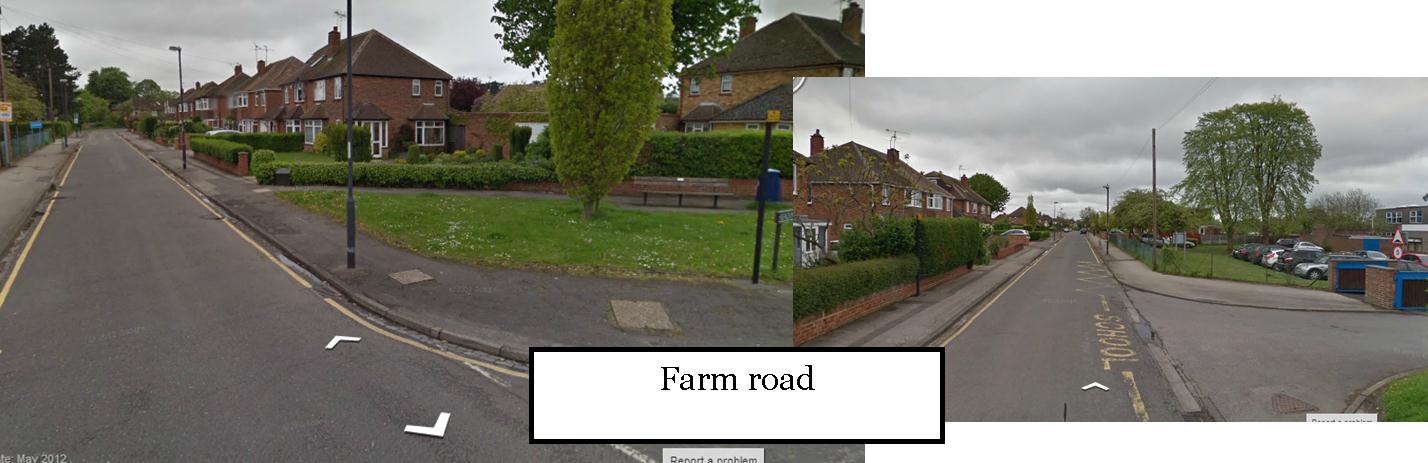
Our third location is Farm road, which will serve purpose for the first half of our opening, when there are still humans alive. It is surrounded with hoses, and is often quite busy, due to it's location near the school, and in a housing area, so would make the place look inhabited and natural, which is what we desired.
White Waltham:

For the test shot we decided to look at places that would normally be quite busy, and then make them look deserted /derelict. For one of these, this was White Waltham school.
Bottle Lane:

Shottesbrook:


White Waltham:

For the test shot we decided to look at places that would normally be quite busy, and then make them look deserted /derelict. For one of these, this was White Waltham school.
Bottle Lane:

Another one of our test shots was of a road, as you would expect to see cars driving down the road, but we used this road, as at certain times of the day there aren't many cars driving down it, and so gave it a spooky edge.
Shottesbrook:


Shottesbrooke park is also an ideal location, as, although it does contain a small estate of very old houses and a church, which makes the place look very picturesque, and at times very spooky, the place is closed off, and so would give us the desired effect of the place being deserted.
Subscribe to:
Posts (Atom)